
Dr. Penny Patterson
President and Director of Research
The Gorilla Foundation / Koko.org

For years, African governments have accused the international criminal court of unfairly targeting leaders from the continent. Their proposed alternative – the African court of justice and human rights – was intended to give the continent a home-grown solution. But on Monday, in a move that one rights campaigner called an own goal, leaders stripped the court – which has yet to begin work – of power to prosecute them for genocide, war crimes or crimes against humanity.
At an African Union summit last week in Equatorial Guinea – often spotlighted for its own rights abuses – heads of state and officials voted to grant sitting leaders and senior officials immunity from prosecution. The immunity would be valid only while officials are in power, but critics warned it could further encourage attempts to seize office for life. Zimbabwe's Robert Mugabe is the world's longest-ruling leader, and African heads of state make up roughly half of the globe's top 10.
The decision rolls back half a century of developments in international human rights and criminal justice law, said Kenyan activist Njonjo Mue. Other courts of last resort, such as the international criminal court (ICC), can prosecute sitting or past leaders who typically have immunity in their national courts.
"It's a joke," said Mue, programme director at the Nairobi-based Kenyans for Peace With Truth and Justice. "The [African] court has been cited as an African solution to African problems, but by granting themselves immunity they put themselves out of reach of the institution. Ninety per cent of the crimes [the court investigates] will be by senior officials in power … It's an own goal because it means victims have no choice but to turn to the ICC for justice."
The ICC was set up a decade ago to try those accused of the worst international crimes, but some global powers – including Russia and the US – don't recognise its jurisdiction. However, the Hague-based institution's most strained relationship has long been with African leaders. All eight people it has indicted are African. Its current chief prosecutor, Fatou Bensouda, from Gambia, faced renewed accusations of bias when prosecutors – as opposed to governments or the UN – initiated their first case, against the Kenyan president, Uhuru Kenyatta, and his deputy, William Ruto, for fomenting ethnic bloodletting after a disputed 2007 election. About 1,200 people died in the violence. The seven other African cases were all referred to the ICC by governments or the UN.
Survivors of some of the civil conflicts that raged through west Africa in the 1990s – and helped bring about the ICC's creation – also expressed dismay at the African court's draft constitution.
Sorie Sawanah, a former taxi driver, had his arm chopped off by drug-crazed child soldiers rampaging through Sierra Leone's capital, Freetown, in 1999.
"He doesn't want to speak on that – it just pains him," said his son Ibrahim, when told about African leaders being granted immunity from prosecution.
Both men said they had felt "at peace" in April 2012, when Charles Taylor became the first African president to be prosecuted at an international court. A UN-backed special court for Sierra Leone found the former Liberian president guilty of aiding and abetting war crimes and crimes against humanity for supporting rebels who carried out atrocities in Sierra Leone – such as the one in which Sawanah lost his arm – in return for "blood diamonds".
Not everybody is critical of the proposed new court. Assiatou Bamba, a trader, who was forced to flee with two children from her home in Ivory Coast's capital, Abidjan, during the 2011 conflict, said prosecutions went against a traditional spirit of reconciliation.
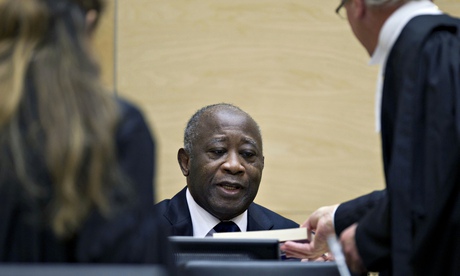
The former Ivory Coast president Laurent Gbagbo is awaiting trial at The Hague. Gbagbo, 69, is accused of plunging his country into civil war instead of relinquishing power after losing elections in 2010.
"Here in Ivory Coast we witnessed terrible things," said Bamba, whose home was shelled during the conflict. "But now, what good does it do to drag up the past? Besides, we have a culture of respecting those in position of authority, and – whatever wrong they have done – our leaders shouldn't be humiliated in a court."
Such sentiments of reconciliation were partly behind the creation of Rwanda's controversial Gacaca courts (although they did not try leaders). The word means "grass" in the country's Kinyarwanda language, referring to the place where communities traditionally gathered to resolve disputes. The courts combined modern criminal law with more traditional informal community procedures.
Bamba's husband, Aboubacar, dismissed arguments that reconciliation meant leaving crimes unpunished. "Being in a position of authority does not mean having the right to slaughter those beneath you like chickens," he said.
Amnesty International said the decision by African leaders to grant themselves immunity was "a step backward for justice".
"At a time when the African continent is struggling to ensure that there is accountability for serious human rights violations and abuses, it is impossible to justify this decision, which undermines the integrity of the African court of justice and human rights, even before it becomes operational," said the organisation's Africa director, Netsanet Belay
Israeli riot police take position behind a car during clashes with Palestinian stone-throwers in Shuafat, an Arab suburb of Jerusalem July 2, 2014.
Credit: Reuters/Ammar Awad
JERUSALEM (Reuters) - The body of an abducted Palestinian youth was found in Jerusalem on Wednesday, raising suspicions he had been killed by Israelis avenging the deaths of three abducted Jewish teens.
News of the discovery of 16-year-old Mohammed Abu Khudair, who was last seen being bundled into a van earlier in the day, triggered clashes between rock-throwing Palestinians and Israeli police in the city.
Palestinian President Mahmoud Abbas accused Jewish settlers of killing Abu Khudair and demanded that Israel "mete out the strongest punishment against the murderers if it truly wants peace".
Israeli Prime Minister Benjamin Netanyahu urged police "to swiftly investigate who was behind the loathsome murder and its motive". He called on all sides "not to take the law into their own hands".
Police said they had found a body in the wooded outskirts of Jerusalem. Abu Khudair's father told Reuters the force had told him the body was his son.
An Israeli security source said Israel suspected the youth had been kidnapped and murdered, possibly in retribution for the killings of the Israeli teens. Their bodies were discovered on Monday, nearly three weeks after they were abducted in the occupied West Bank.
Israel says Palestinian Hamas militants killed them. The Islamist group has neither confirmed nor denied the allegation.
The White House condemned the killing of Abu Khudair and called on Israel and the Palestinian Authority to "take all necessary steps to prevent an atmosphere of revenge and retribution."
Netanyahu convened his security cabinet later on Wednesday as violence also flared up across the Israel-Gaza border, with Palestinians firing at least a dozen rockets and mortars, and Israel's military carrying out an air strike.
Abu Khudair's cousin said the 16-year-old was grabbed off the street after leaving his home in Jerusalem's Arab neighbourhood of Shuafat to go to morning prayers with friends.
"Somebody ran into the house to say one of the boys had been dragged into a white van, so (Mohammed's) mother called the police," the cousin, Naima, said.
The abduction came a day after the three Jewish seminary students - Gil-Ad Shaer and U.S.-Israeli national Naftali Fraenkel, both 16, and Eyal Yifrah, 19 - were buried in a funeral attended by tens of thousands of mourners.
While the teenagers were laid to rest in the city of Modi'in, several hundreds Israeli demonstrators, some chanting "Death to Arabs", blocked the main entrance to Jerusalem.
Cries for revenge have echoed throughout the decades-old Israeli-Palestinian conflict.
They can be heard at the emotionally charged funerals of Palestinians killed by Israel, and the phrase "May God avenge his death" is often invoked at the burials of Israelis slain by Palestinians.
But deadly Israeli vigilante attacks, in declared retribution for Palestinian assaults, have been rare in recent years.
More common are the so-called "price tag" incidents in which mosques and Palestinian property are torched or damaged - originally a reference by ultra-nationalist Jews to making the government "pay" for any curbs on Jewish settlement on land Palestinians seek for a state.
Hebrew graffiti found on a building in the West Bank city of Nablus on Wednesday read: "Price tag, Jewish revenge."
Tensions were high in the West Bank, where around 40 Palestinians were arrested in raids on Tuesday, the latest in a campaign by Israel to cripple Hamas there.
Four people were wounded by live bullets early on Wednesday in an Israeli raid in the Palestinian city of Jenin.
Near Hebron, Israeli forces destroyed the home of a Palestinian arrested on charges of shooting dead an off-duty police officer in the West Bank in April.
Israel, which suspended the demolition policy in 2005 as a Palestinian uprising waned, says destroying the homes of Palestinians involved in attacks on Israelis has a deterrent effect. Rights groups have condemned the practice as collective punishment.
http://www.reuters.com/article/2014/07/02/us-israel-palestinians-idUSKBN0F70AD20140702

